

Still Here:
Eight Years of Illness, Adaptation, and Learning How to Live Again

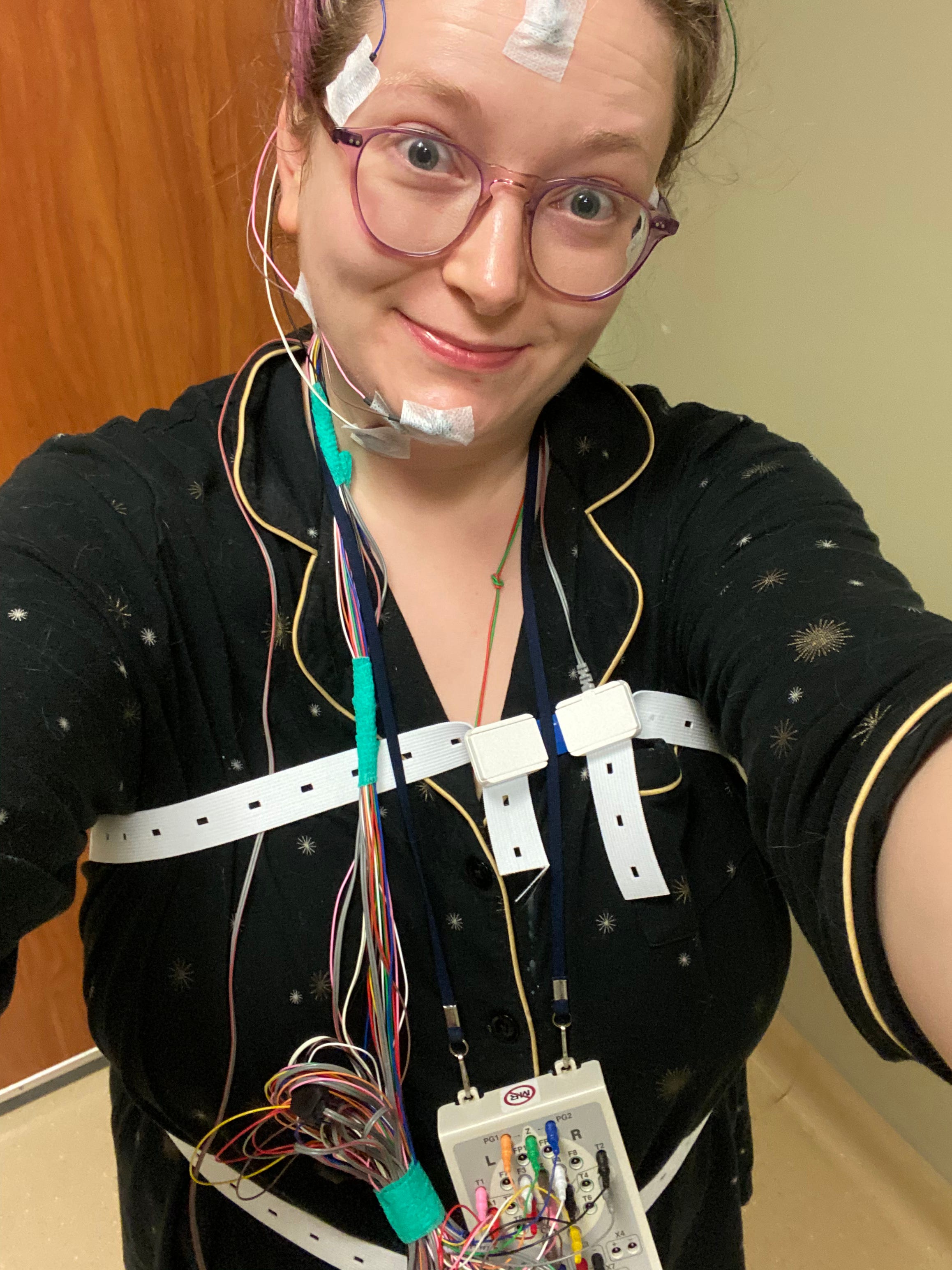
(Why am I smiling in the photo above? I must have been excited to be closer to diagnosis. But comprehensive sleep testing was…a test, at best. I remember those 24 hours as some of the most harrowing of my life.)
This week, I sat across from a very old friend over dinner and realized how much of my story they didn’t know.
Not because I’ve been hiding it—though sometimes I have—but because chronic illness doesn’t unfold in a single, tellable arc. It stretches. It shapeshifts. It becomes background noise to your own life. And unless you pause to name it, years can pass without my ever saying, This is what it’s been like inside my body.
So this is me filling in some gaps. For them. For you. Maybe for myself, too.
It Started With Fatigue—But Not the Kind People Mean
The first symptom wasn’t pain. It wasn’t anxiety. It wasn’t sadness.
It was fatigue so profound it didn’t resemble being tired after a bad night’s sleep. This was the kind of fatigue that sleep doesn’t fix. The kind that feels cellular. Heavy. Disorienting.
Fatigue from chronic illness—and from sleep disorders like idiopathic hypersomnia and obstructive sleep apnea, which I was later diagnosed with—has been compared to being awake for over 24 hours straight and being expected to function normally (thanks, capitalism). Except it happens day after day.
Eventually, I couldn’t reliably get to work. Then I couldn’t get out of bed. Later, I was functionally trapped at home for over a year.
Brain fog followed quickly: difficulty finding words, losing trains of thought mid-sentence, struggling to read or retain information, feeling like my cognition was wrapped in cotton. Cognitive fatigue became its own kind of exhaustion—one that made thinking itself feel effortful.
Diagnoses, Dominoes, and a Body in Alarm Mode
The first official diagnosis was Hashimoto’s thyroiditis.
Anecdotally, I’ve noticed something many people with Hashimoto’s will recognize: about 75% of folks do reasonably well once prescribed thyroid hormones (they probably don’t have multiple additional diagnoses, to boot). And then there’s the other 25%—the ones whose lives get turned upside down.
I was in that 25%.
Sleep disorder diagnoses followed. Then gastroparesis and chronic constipation. Then a car accident that left me with chronic back pain I still manage daily. My body wasn’t detoxing effectively. My nervous system was stuck in fight-or-flight. Inflammation became my baseline.
Heat intolerance showed up early and never really left.
Over time—and only by continuing to dig when answers didn’t add up—I learned that much of this cascade had been triggered years earlier by toxic mold exposure in my home.
That exposure led to CIRS: Chronic Inflammatory Response Syndrome. In simple terms, it’s what happens when the immune system doesn’t shut off after a biotoxin exposure. The body stays inflamed, reactive, and overwhelmed, affecting everything from cognition to digestion to sleep to pain perception.
Parasites were part of this picture, too.
Letting Go—Literally and Otherwise
I spent over a year in parasite detox. It was harrowing. Constant nausea. Deep discomfort. And the surreal experience of seeing—dead and alive—what my body had been carrying.
What surprised me most was the emotional layer.
As I let go of old identities, ended a relationship, and grieved the life I thought I was supposed to have, my body released too. I don’t say this metaphorically. The mind-body connection was undeniable. Releasing emotional weight coincided with physical release in ways that were impossible to ignore.
At the same time, my circadian rhythm was profoundly disrupted. For years, I couldn’t function before 11am or noon, which made traditional employment nearly impossible. Eventually, I took several months to fully reset my sleep-wake cycle—using grounding, sleep optimization, and nervous system regulation.
Today, I wake up around 7am most days. I work full time. That still feels miraculous.
Rebuilding a Life, Piece by Piece
In the midst of all of this, I became a patient advocate. I launched Uninvisible Pod. People started asking me for help navigating their own health journeys. That’s how I found health coaching—and why I leaned into it.
My relationship with movement had to change completely. Post-exertional malaise means I have to be gentle. Perimenopause (and early perimenopause, in fact) has added new layers. But in my case, if I don’t move at all, I lose the ability to keep moving. So I maintain daily mobility work and ongoing structural care.
Nervous system work (or, in other words, holistic biomechanics) with Amy Bonaduce-Gardner at Prism Movement Studio (whose work I was brought to by the lovely Nitika Chopra) has been life-changing—not in terms of dramatic overhauls, but in subtle, cumulative shifts that have attuned me more deeply to my body’s signals.
Food changed too. After years of dieting in a culture that trains women to shrink themselves, I shifted from eating for weight loss to eating for health. A close friend helped me start cooking at home when I went on AIP (the Autoimmune Protocol, which I first learned about from Sascha Alexander) for three months. That reset everything. I’m now largely paleo and strictly gluten-free (doctor’s orders)—a massive GI game-changer.
Rest became non-negotiable. Not something earned. Not a reward. Sometimes simply the only option (and a great one, at that).
Friendships changed. Some fell away. Others deepened. New ones emerged. I learned—slowly—that not every relationship is meant to travel every season with me.
I’ve gained and lost weight. I’ve had to renegotiate my relationship with my body and my reflection. Body dysmorphia has been part of that work, too.
And still—after international travel, it takes me about a month to fully recover. I’m good most days, but I’m not cured. I’m managing. I’m listening. I’m adapting.
✦ Considerations for Learning to Thrive
There are a few things I believe have been essential to my ability to move beyond survival—and they’re things I now name explicitly in my work with clients.
• An early, often unconscious decision that this wouldn’t be the end of my life. That I would find my way back to thriving—not unchanged, but still expansive and meaningful. This belief wasn’t magical thinking. It was scaffolded by real support.
• Lineage matters. I was shaped by my mother—an indomitable, glass-ceiling-shattering journalist who learned not to take no for an answer when women were still fighting for the right to work at all. Her insistence on asking better questions lives in me.
• Your context matters—personally and more globally. In exploring the lineage of your relationship to your thought and your perception of self, we also have to consider the ways in which the world has shaped you: how these layers of identity, from the inner child to the wider world—and the systems that play a role in our identity and access to care—can influence our experiences and decisions. In the midst of it all, we have to remember something I remind my clients of all the time: that you are not responsible for the systems that challenge and oppress you, but that you are responsible for finding ways to thrive despite them…and without perpetuating further harm.
• The willingness to lean into support. Vulnerability didn’t come easily. Letting people see how bad things were required me to soften places I’d previously armored.
• Being toughened and softened at the same time. Chronic illness taught me discernment, advocacy, and when to push versus yield. It stripped me down to essentials.
• Reframing illness as opportunity. This one is loaded, and I recognize that. It has taken me years to land at this hot take. But I now understand that losing my health was the opportunity to reconnect to my body in a world that constantly taught me to dissociate from it (especially as a woman). From as early as my first period and into my young adult life, I can look back and tell you that I was in pain and discomfort but never discussed it or showed it outwardly. That has changed. It had to. Because living in pain and discomfort is no longer an option for me—and because I realize that changing that narrative within has allowed me to find some version of healing and wholeness. One that I can offer to others, too.
Thriving, I’ve learned, isn’t about erasing hardship. It’s about meeting reality with honesty, support, and the belief—sometimes borrowed—that more is still possible.
Why This Matters to My Work
All of this informs how I coach.
I work at the intersection of chronic illness, neurodivergence (I identify strongly with ADHD, diagnosed or not), menopause, and healthcare advocacy—not from theory, but from lived experience.
I understand capacity not as a productivity concept, but as a daily, moment-to-moment negotiation across physical, emotional, cognitive, and financial realities. I know what it’s like to start at the bottom. To still be going. To need both structure and softness.
All this to say: I get it.
I’ve been where you are. In many ways, I’m still there. And I also know that there are ways—plural—to move from surviving to something steadier. From fight to flow. From collapse to connection.
I’m still here.
Questions? You know where to find me.
And I’ll keep showing up here, sharing and naming what I’m noticing. I hope you’ll continue to follow along.
Loved this post! So glad nervous system work has been supportive for you and I’m always sending love your way ❤️♥️
Thank you. So many things resonated. I, too, have been toughened but softened. I’m still early in my chronic illness journey (5 years) but it really has led me back to myself and my roots. I listen to my body so much more. I am kinder (though no way perfect). I’ve also learned that while I may not have much control of my symptoms on a given day, I can control
The story I tell myself about them. My mom always taught me that tomorrow is another day and hold tight to that idea.